
Ink Backflow and Vibration in Fine Line & PMU: The SP5 Tattoo Cartridge Needle Fix
Ink Backflow and Vibration in Fine Line & PMU: The SP5 Tattoo Cartridge Needle Fix
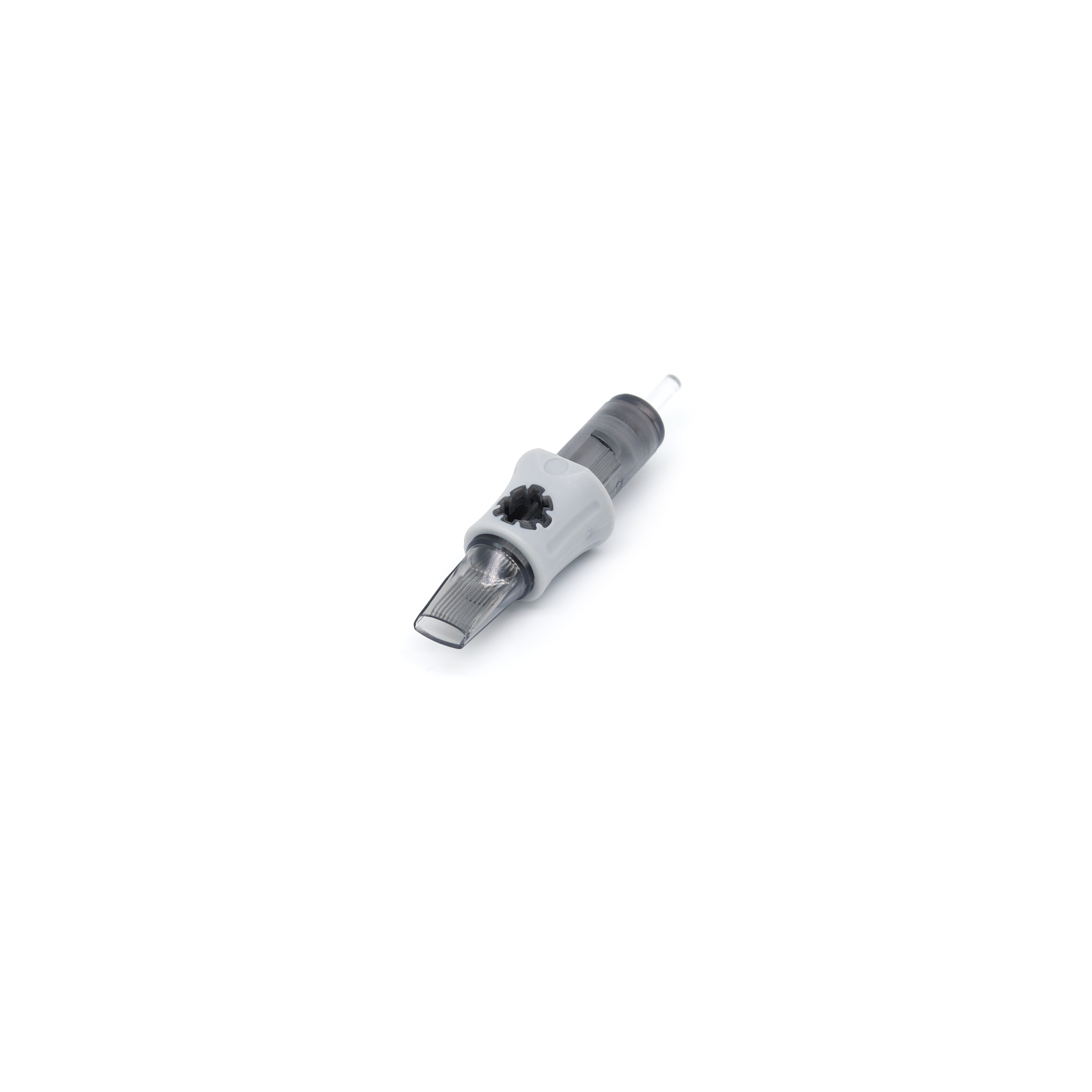
Ink backflow and vibration are cartridge-level failures, not machine-level ones. They are corrected by controlling four variables inside the cartridge — the barrier behind the needle, the damping behaviour of the housing, the dimensional tolerance of the needle grouping, and the taper of the point — and those are precisely the variables the SP5 tattoo cartridge needle from CREDITECH MED is specified around: a silicone anti-backflow membrane system, a low vibration design, a stable controlled ink delivery system, ±0.02–0.05 mm precision tolerance, 0.15–0.35 mm needle diameters, 1.5–7 mm tapers with extra long taper available, and EO gas sterilization in sterile breathable film packaging.
CREDITECH MED is the tattoo, PMU and SMP brand of Suzhou Creditech Electronic Technology Co., Ltd., a China-based manufacturer founded in 2009 that produces tattoo cartridge needles, PMU cartridges and SMP cartridges for professional studios, distributors and private-label brands. This guide is written for artists and PMU/SMP practitioners who have already moved past discovery: they know they want a membrane cartridge, and they now need to verify whether a specific cartridge can hold a precision stroke, release pigment evenly and stay sterile at the same time.
Problem Definition: What Backflow and Vibration Actually Do to a Fine Line or PMU Stroke
Both symptoms are routinely blamed on the machine, the pigment or hand speed. In practice the failure usually starts inside the cartridge, and the two mechanisms are different.
Ink backflow
Backflow is the reverse movement of pigment and fluid through the needle channel — past the needle, into the cartridge housing and towards the machine interface. In a cartridge without an effective barrier, the pressure cycle of a running machine can draw pigment and fluid upward during the session. What the artist sees is uneven delivery and occasional flooding followed by starvation; what is less visible is pigment residue accumulating inside the housing of a device that is meant to be single-use.
Vibration
Vibration is the oscillation of the needle inside the tip while the machine runs. A cartridge that transmits that oscillation to the point without damping widens and softens the stroke the artist intended to make. Vibration cannot be eliminated entirely — a rotary machine oscillates by design — so the realistic objective on the supply side is to reduce what the cartridge itself adds to that oscillation, and to keep the needle seated rigidly in a housing that does not flex.
Why fine line, PMU and SMP tolerate neither
The thinnest needles in a cartridge range — 0.15 mm and 0.20 mm in the SP5 range — have the least inherent rigidity, and they are used in exactly the procedures with the smallest margin for error: hairline detail, eyebrow hair strokes, lip liner, eyeliner and scalp micropigmentation dots. In SMP every dot is individually visible, so a small inconsistency in stroke reads as patchiness across the treatment area rather than as one blurred line. For these procedures, cartridge choice is a constraint problem: tolerance, taper, membrane and vibration behaviour all have to be confirmed before price and packaging enter the conversation.
Industry Background: Why Cartridge Specification Became the Buying Decision
Cartridge formats now dominate professional practice. In 2024, approximately 73% of professional tattoo artists preferred needle cartridges over traditional bar needles, according to survey data cited by Custom Market Insights. The same source estimated the global tattoo needle market at USD 368.3 million in 2024, projected to reach USD 468.6 million by 2033 at a CAGR of approximately 3.5%.
The faster-growing segment is cosmetic. Fortune Business Insights projects the global permanent makeup market rising from USD 162.93 million in 2025 to USD 330.5 million by 2034, a CAGR of 8.31%. Growth of that scale brings buyers into the category who judge a cartridge on pigment control and stroke precision rather than on price per box, and who ask for documentation rather than for brand familiarity.
Documentation expectations have tightened with it. ISO 13485:2016 is the quality management system standard applied to medical-grade tattoo needle manufacturing, and professional buyers increasingly request the certificate number, issuing body, scope and expiry date instead of a compliance logo. Cartridge needles are also traded under HS code 9018.39, the medical needle classification, which places them in a regulated consignment category for customs and market-access purposes.
The practical consequence for a fine line or PMU buyer is that the cartridge is now a specified component with a paper trail. A supplier who cannot produce the certificate number behind a claim cannot support a professional studio's own compliance file, however good the sample performs.
The SP5 Solution: Six Design Constraints Mapped to the Two Symptoms
1. Silicone anti-backflow membrane system
Inside the SP5 cartridge, a silicone elastic membrane sits behind the needle as a physical barrier. It addresses backflow directly: pigment and fluid are held on the working side of the membrane instead of being drawn into the housing. The membrane is silicone rather than a rigid seal, which matters because it must flex with the needle stroke thousands of times in a session without losing contact.
2. Low vibration design and a rigid medical-grade PC housing
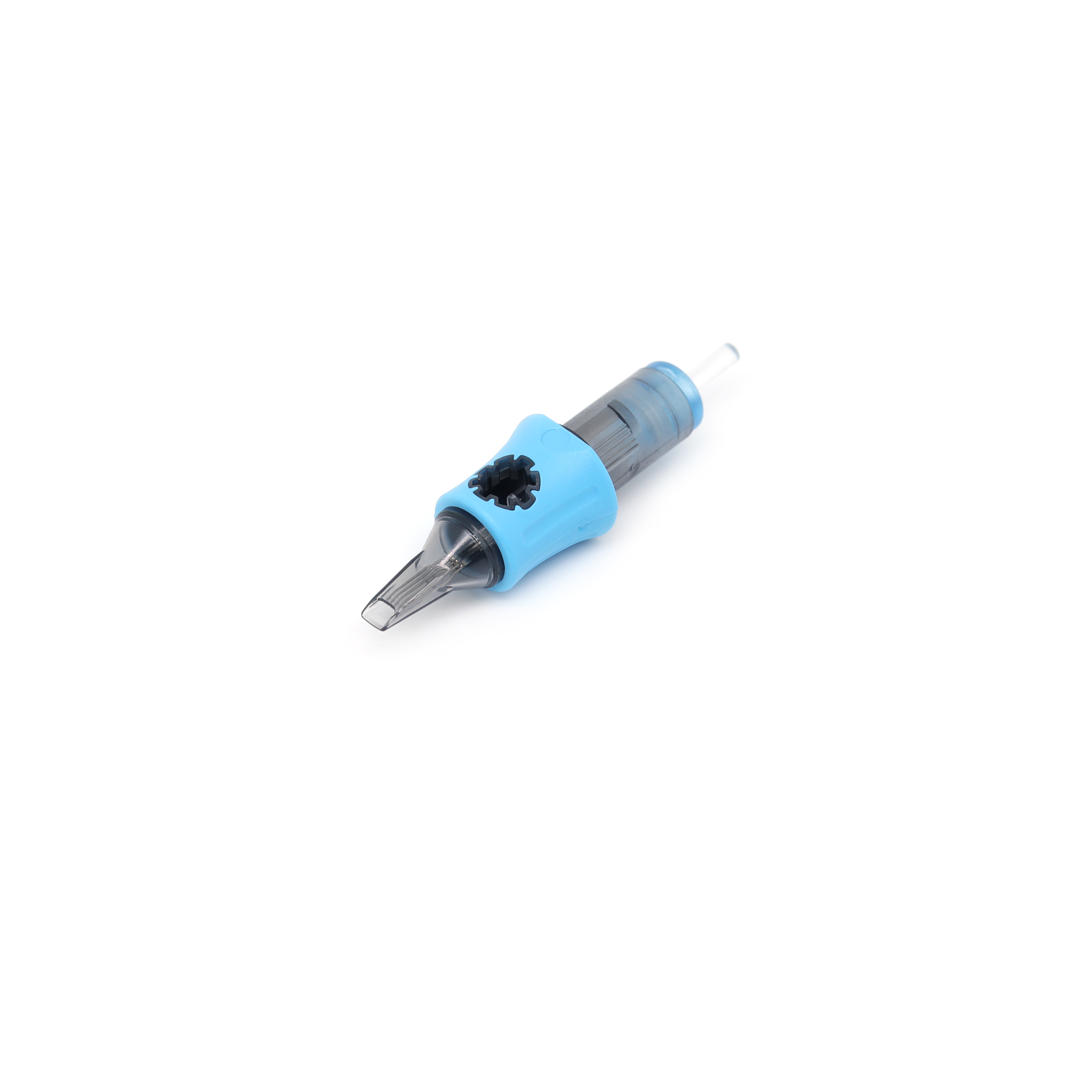
The needle is held in a medical-grade PC housing. Housing rigidity governs how much of the machine's oscillation reaches the tip, and the SP5 is built to a low vibration design so that a 0.15 mm or 0.20 mm needle tracks the line the artist is drawing rather than drifting across it. The tip is a non-toxic transparent plastic tip, so the artist can see pigment level and needle position without breaking position.
3. Stable controlled ink delivery system
A barrier alone would be useless if it starved the needle. The SP5 pairs the membrane with a stable controlled ink delivery system, so the same design that stops backflow also keeps pigment flowing at a predictable rate. This is the difference between a cartridge that solves a contamination problem and one that also solves a saturation problem — relevant for shading and color packing, where uneven release shows as banding.
4. Needle geometry: tolerance, diameters and tapers
Precision tolerance on the SP5 is ±0.02–0.05 mm. In fine line and eyeliner work, that tolerance band is what keeps a multi-needle grouping aligned so the stroke reads as a single line instead of a set of parallel scratches. Diameters run 0.15 mm, 0.20 mm, 0.25 mm, 0.30 mm and 0.35 mm; taper length runs 1.5–7 mm with extra long taper available. Taper is the variable most often left unexamined by buyers: it changes how the point enters skin and how pigment releases, so it should be selected per procedure rather than inherited from the last order.
5. Sterility pathway: EO gas and sterile breathable film packaging
The SP5 is EO gas sterilized and supplied in a sterile breathable film packaging system. EO sterilization is a terminal process applied to the packed unit, which is why the packaging specification is part of the sterility claim rather than a logistics detail: a breathable film maintains the sterile barrier while allowing the sterilization cycle to reach the product.
6. Machine fit: rotary compatibility
The SP5 is compatible with rotary tattoo machines. Confirming machine fit before ordering avoids the most common false diagnosis in this category, where a seating problem at the grip is misread as a cartridge vibration fault.
SP5 specification summary
| Specification | SP5 detail |
|---|---|
| Needle material | Medical-grade stainless steel needles |
| Housing material | Medical-grade PC housing |
| Tip | Non-toxic transparent plastic tip |
| Barrier | Silicone anti-backflow membrane (silicone elastic membrane system) |
| Precision tolerance | ±0.02–0.05 mm |
| Needle diameter | 0.15 mm / 0.20 mm / 0.25 mm / 0.30 mm / 0.35 mm |
| Taper length | 1.5 mm – 7 mm (extra long taper available) |
| Configurations | RL / RS / RM / Magnum / Flat |
| Product families | Fine Line, Traditional, Shading, Color Packing, PMU Eyebrow, SMP Scalp Micropigmentation, Long Taper Precision, Soft Edge Magnum |
| Ink flow | Stable controlled ink delivery system |
| Vibration | Low vibration design |
| Sterilization | EO gas sterilized |
| Packaging | Sterile breathable film packaging system |
| Compatibility | Compatible with rotary tattoo machines |
Step-by-Step: Matching an SP5 Cartridge to a Fine Line, PMU or SMP Procedure
Step 1 — Separate the symptom before changing the cartridge
Decide whether the failure is backflow (pigment in the housing, flooding then starvation) or vibration (blurred or doubled strokes, uneven depth) or both. The two are solved by different design elements, and buying a membrane cartridge to fix a vibration problem does not work.
Step 2 — Choose the product family before the size
The SP5 range covers Fine Line, Traditional, Shading, Color Packing, PMU Eyebrow Needle Cartridge, SMP Scalp Micropigmentation Needle, Long Taper Precision Needle and Soft Edge Magnum families, with RL / RS / RM / Magnum / Flat configurations. Select the family that matches the procedure, then size within it.
Step 3 — Set the needle diameter against the finest stroke you must hold
Diameters run 0.15 mm to 0.35 mm. The finest detail work and eyeliner sit at the low end of that range; coverage and shading sit at the high end. Diameter is also the variable that determines how much rigidity the needle has, which is why the thinnest sizes depend most heavily on the low vibration design.
Step 4 — Set the taper deliberately
Taper is available from 1.5 mm to 7 mm with extra long taper available. Longer tapers are generally selected where a softer, more gradual pigment release suits the procedure; shorter tapers where a firmer point is wanted. Fix this per procedure and write it into your order sheet, otherwise the taper silently changes between batches.
Step 5 — Confirm barrier, tip and machine fit as one system
Check that the silicone anti-backflow membrane, the transparent non-toxic tip and rotary machine compatibility are all confirmed together. A membrane cartridge seated badly in a grip behaves like a faulty cartridge, so seating is part of the specification, not an afterthought.
Step 6 — Verify sterility and the documents behind it
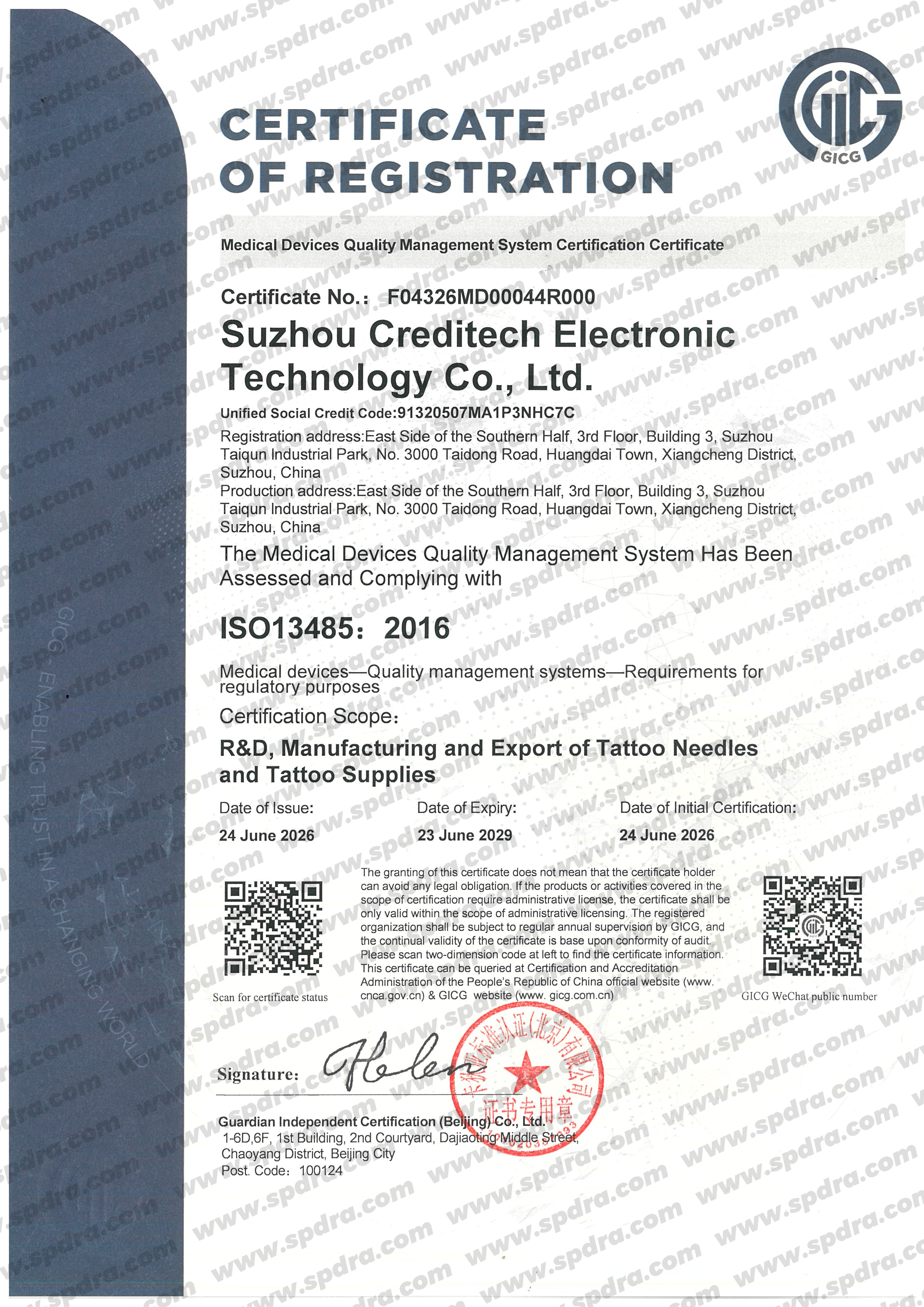
Ask for the sterilization method (EO gas), the packaging format (sterile breathable film packaging system) and the certificates with numbers. CREDITECH MED's quality management system is certified to ISO 13485:2016 under certificate F04326MD00044R000, issued by Guardian Independent Certification (Beijing) CO., LTD. for the research, development, manufacturing and sales of tattoo needles, with a validity of 24 June 2026 to 23 June 2029. The SP5 is also covered by CE MDR document review ICR Polska/DR/HM2311112 issued by ICR Polska Co. Ltd. against MDR (EU) 2017/745 Annex II & Annex III, valid to 29 November 2028, and by an FDA testing report, number TST2019112501-4EN, issued by TST Testing Technology Co., Ltd. against FDA 21CFR175.300, FDA 21CFR180.22 and ASTM C738-94 for the US market.
Step 7 — Validate on a sample batch, then set order quantities
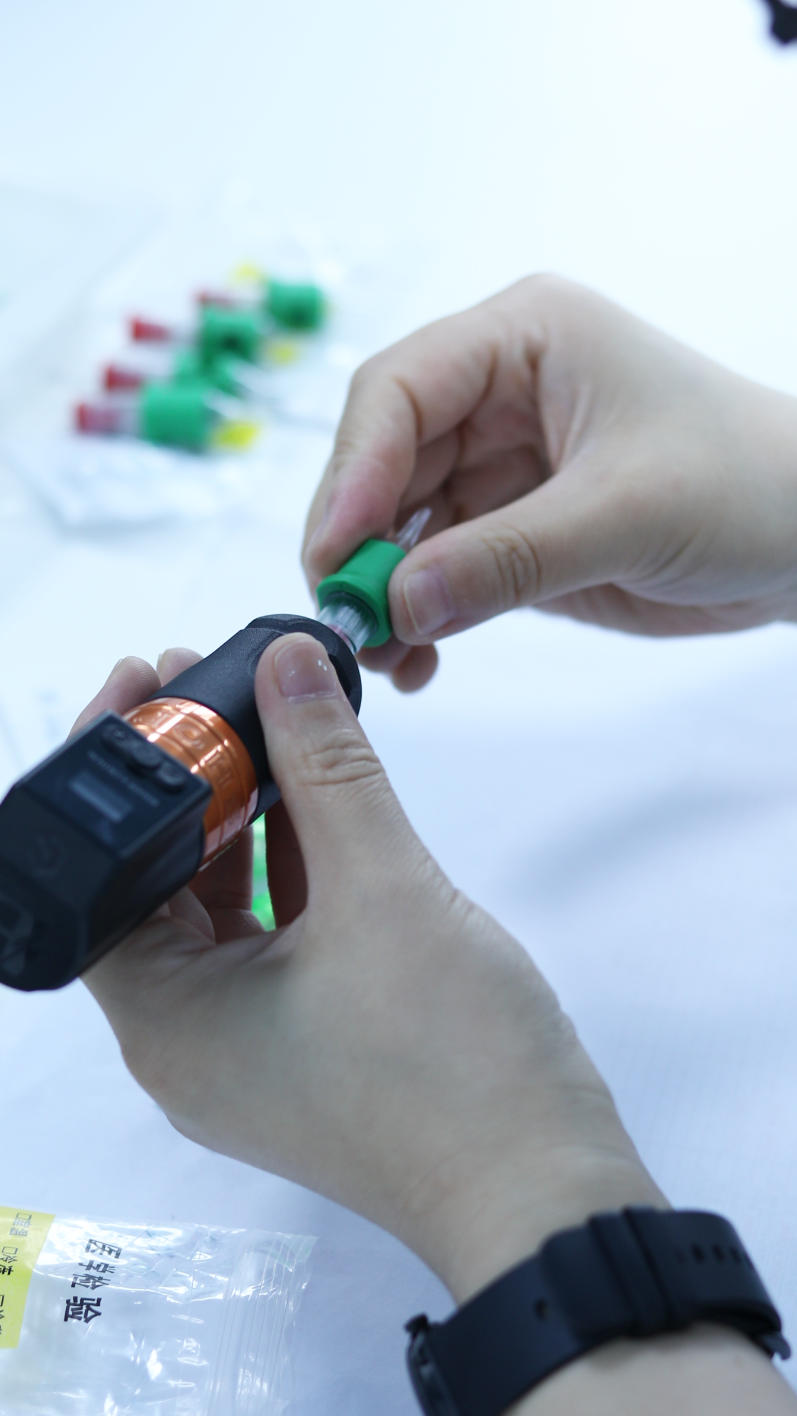
Run the chosen configuration and taper on your own machine and pigment before committing volume. Once the configuration is fixed, quantity terms are straightforward: minimum order is 500–1,000 pcs per size, lead time is 15–30 days for standard orders and 30–45 days for custom OEM orders, against a monthly capacity of 3,000,000+ cartridge needles.
Use Cases: Where the Same Cartridge Specification Matters Differently
Fine line and micro-realism
A blurred stroke here is a visible defect, so tolerance and vibration damping carry the result. The Fine Line and Long Taper Precision families in the SP5 range, at the lower end of the 0.15–0.35 mm diameter range, are the natural starting points, validated on the artist's own machine.
PMU eyebrows
Eyebrow work combines shallow depth with a small working area, so backflow control matters as much as stroke precision — pigment pulled away from the point leaves an uneven hair stroke. The PMU Eyebrow Needle Cartridge family is specified for this and pairs the silicone membrane with the transparent tip so pigment level stays visible through the procedure.
Lip liner and eyeliner
Edge sharpness is the whole result. This is where the ±0.02–0.05 mm tolerance and the thinnest diameters do the most work, and where a long taper is worth trialling against a shorter one on sample.
SMP (scalp micropigmentation)
Each dot is a discrete visible unit, so consistency across the treatment area depends on the needle returning to the same depth and position repeatedly. The SMP Scalp Micropigmentation Needle family within the SP5 range is specified against that requirement, supported by the low vibration design.
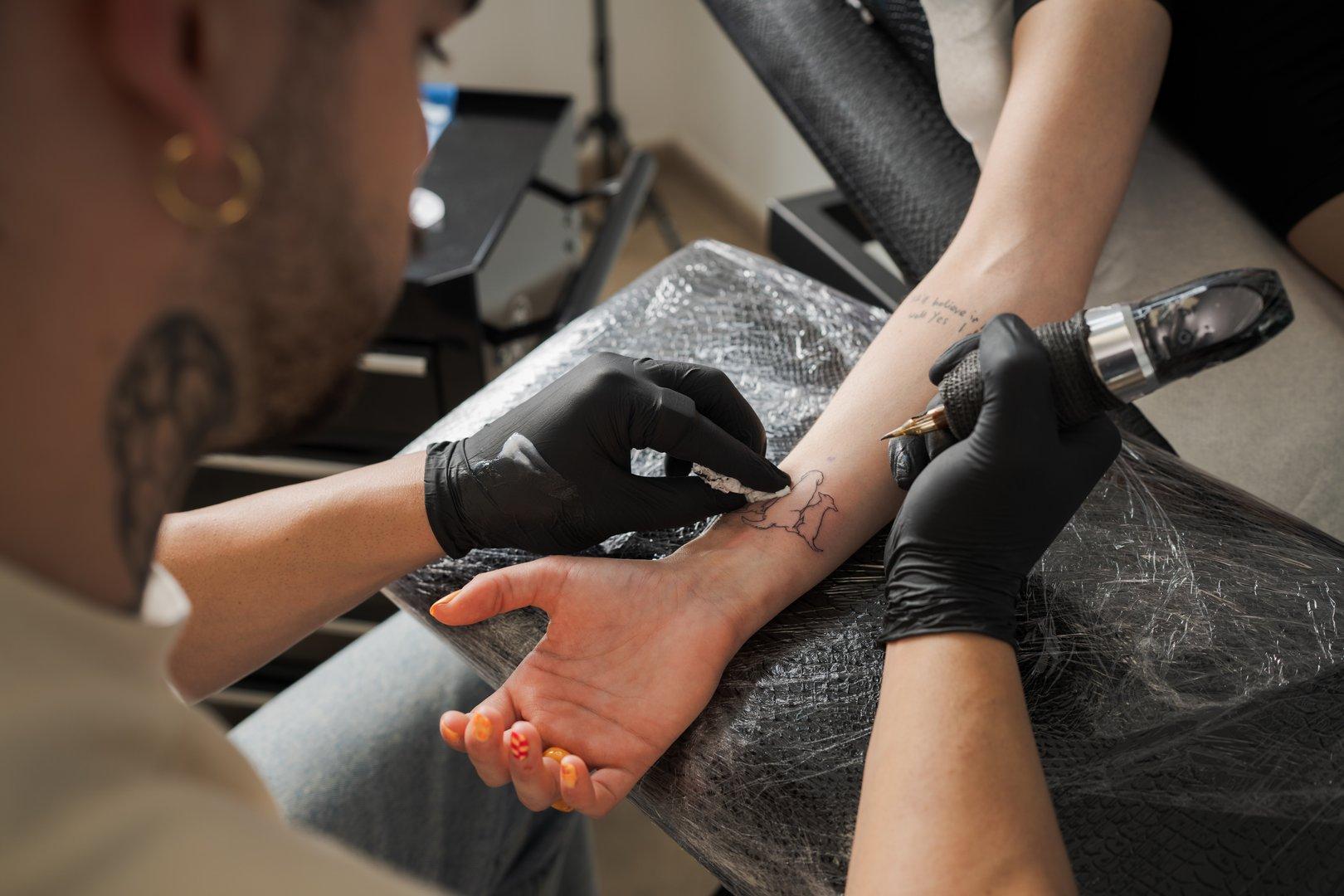
Shading, blending and color packing
Here the constraint shifts from stroke precision to pigment volume. The Shading Cartridge Needle, Color Packing Cartridge Needle and Soft Edge Magnum families carry the stable controlled ink delivery system into larger coverage work, together with the RS and Magnum configurations in the SP5 range.
Comparison Table: Symptom, Failure Mode and the SP5 Counter-Specification
| Constraint | What goes wrong without it | SP5 specification | Where it shows first |
|---|---|---|---|
| Anti-backflow barrier | Pigment and fluid drawn into the housing; uneven delivery on a single-use device | Silicone anti-backflow membrane system | Fine line, PMU, SMP |
| Vibration damping | Wider, softer stroke; inconsistent depth | Low vibration design | Fine line, SMP |
| Housing rigidity | Tip flex and needle wander | Medical-grade PC housing | All procedures |
| Ink delivery stability | Flooding followed by starvation; banding | Stable controlled ink delivery system | Shading, color packing, lip work |
| Dimensional tolerance | Grouping misalignment; doubled lines | ±0.02–0.05 mm precision tolerance | Fine line, eyeliner |
| Diameter availability | Wrong needle for the stroke width | 0.15 / 0.20 / 0.25 / 0.30 / 0.35 mm | All procedures |
| Taper control | Point behaves differently batch to batch | 1.5–7 mm, extra long taper available | Fine line, brows, SMP |
| Sterility | Unverified sterile barrier at point of use | EO gas sterilized; sterile breathable film packaging system | All procedures |
| Machine fit | False vibration diagnosis from poor seating | Compatible with rotary tattoo machines | All procedures |
Selection Checklist: Matching SP5 Configuration and Taper to the Procedure
| Procedure | SP5 family to start from | Diameters in range | Taper options | What to validate on sample |
|---|---|---|---|---|
| Hairline detail / micro-realism | Fine Line; Long Taper Precision | 0.15 / 0.20 / 0.25 mm | 1.5–7 mm; extra long available | Line consistency across a full pass |
| Eyebrow strokes (PMU) | PMU Eyebrow Needle Cartridge | 0.15 / 0.20 / 0.25 mm | Long to extra long | Stroke crispness; no pigment in housing |
| Lip liner / eyeliner | PMU Eyebrow Needle Cartridge; Fine Line | 0.15 / 0.20 mm | Long | Edge sharpness; backflow check after session |
| SMP | SMP Scalp Micropigmentation Needle | 0.20 / 0.25 / 0.30 mm | 1.5–7 mm | Dot uniformity across zones |
| Shading | Shading Cartridge Needle (RS) | 0.25 / 0.30 / 0.35 mm | Short to medium | Smooth transition without banding |
| Color packing / coverage | Color Packing Cartridge Needle; Soft Edge Magnum | 0.30 / 0.35 mm | Short to medium | Saturation without flooding |
Verification checklist before you approve a batch
- Silicone anti-backflow membrane present and intact on the sample unit.
- Needle grouping aligned within the stated ±0.02–0.05 mm tolerance.
- Taper length matches the order sheet, not the previous batch.
- Housing seated firmly in the rotary grip with no detectable play.
- EO gas sterilization declared and sterile breathable film packaging intact.
- ISO 13485:2016 certificate number and scope confirmed against the legal entity.
- CE MDR, FDA testing report, RoHS and MSDS documentation available for your market.
- Batch traceability and 100% inspection confirmed in writing.
FAQ
Which certificates should a sterile tattoo cartridge needle supplier provide for the EU and US markets?
For the EU, look for a medical device quality system certificate and a CE MDR document. CREDITECH MED holds ISO 13485:2016 certification, certificate number F04326MD00044R000, issued by Guardian Independent Certification (Beijing) CO., LTD., covering research, development, manufacturing and sales of tattoo needles, valid from 24 June 2026 to 23 June 2029. The SP5 cartridge is covered by CE MDR document review ICR Polska/DR/HM2311112, issued by ICR Polska Co. Ltd. against MDR (EU) 2017/745 Annex II & Annex III, valid to 29 November 2028, and by RoHS (2011/65/EU) certificate ICR/VC/HM260680 issued by ICR, valid from 5 June 2026 to 4 June 2031. RoHS 2.0 testing is documented under certificate TST2019112501-3RC from TST Testing Technology Co., Ltd. against (EU) 2015/863, (EU) 2017/2102 and the IEC62321 series. For the US, an FDA testing report is available: report number TST2019112501-4EN from TST Testing Technology Co., Ltd. against FDA 21CFR175.300, FDA 21CFR180.22 and ASTM C738-94. Material safety documentation is held under MSDS certificate BCTC2305199480R, issued by Shenzhen BCTC Testing Co., Ltd. against CLP Regulation (EC) No 1272/2008 and REACH (EC) No 1907/2006.
Does the SP5 anti-backflow membrane affect ink flow or machine compatibility?
No. The silicone anti-backflow membrane is paired with a stable controlled ink delivery system, so the barrier controls reverse movement of pigment without restricting forward flow. The SP5 is compatible with rotary tattoo machines and uses a low vibration design and a medical-grade PC housing to keep the needle tracking steadily. Practically, the membrane solves the contamination and flooding side of the problem while the low vibration design and ±0.02–0.05 mm tolerance solve the stroke-precision side; neither replaces correct matching of diameter, taper and configuration to the procedure.
How do I verify a sterile tattoo cartridge needle manufacturer before placing an order?
Verify in four steps. First, take the certificate number and check the issuing body, the scope and the expiry date, and confirm that the certified scope covers tattoo needle manufacturing and matches the legal entity on your invoice. Second, confirm the sterilization method and packaging: the SP5 is EO gas sterilized and supplied in a sterile breathable film packaging system. Third, ask for batch traceability and the inspection regime; CREDITECH MED operates ISO 13485 quality management with 100% inspection, EO sterilization and batch traceability. Fourth, test a sample from a production batch rather than a hand-built prototype, because the sample is the only evidence of what routine output actually looks like.
What is the minimum order quantity and lead time for SP5 cartridges?
Minimum order quantity is 500–1,000 pcs per size, which allows a studio or distributor to hold several diameters and tapers without over-committing to one configuration. Lead time is 15–30 days for standard orders and 30–45 days for custom OEM orders. Production capacity behind those terms is 3,000,000+ cartridge needles per month, with an annual output of 100,000,000 units.
Can I validate the SP5 configuration and taper on a sample before a full order?
Yes. Fast sample development is part of the OEM and ODM workflow at CREDITECH MED, alongside custom logo, private label, custom packaging, needle configuration and housing design. The sensible sequence is to fix the family, diameter and taper on samples, confirm the membrane and machine fit in your own grip, then scale to production quantities. To start a sample or quotation request, use the contact details below.
Next Step: Test the SP5 Against Your Own Fine Line or PMU Work
Ask for a sample set of SP5 tattoo cartridge needles in your working diameters and tapers, or request a quotation with the configuration list you need. Private-label and OEM buyers can request the full documentation pack, including the ISO 13485:2016 certificate, CE MDR document review, RoHS, FDA testing report and MSDS.
Contact: Yosmine | Phone / WhatsApp: +86 18625276381 | Email: estlia@creditechmed.com
Address: 3rd Floor, Building 3, No. 3000 Taidong Road, Xiangcheng District, Suzhou, China
Website: www.creditechmed.com | WhatsApp chat: message us
Catalogue download: CREDITECH MED corporate brochure
Conclusion
Ink backflow and vibration are not technique problems to be worked around; they are cartridge specifications to be checked. The SP5 tattoo cartridge needle answers both with the same set of documented constraints: a silicone anti-backflow membrane system for the barrier, a low vibration design and medical-grade PC housing for the stroke, a stable controlled ink delivery system for saturation, ±0.02–0.05 mm precision tolerance across 0.15–0.35 mm diameters and 1.5–7 mm tapers with extra long taper available, EO gas sterilization in sterile breathable film packaging, and rotary machine compatibility. Backed by ISO 13485:2016 certification, CE MDR documentation, RoHS, FDA testing and MSDS records, the specification can be audited rather than taken on trust — which is what an evaluation-stage buyer actually needs.
Have Questions or Need More Details?
Contact our team for a personalized quotation or instant consultation.
Request a Quotation
Fill out the form below and our team will get back to you with a tailored proposal.
WhatsApp Direct Chat
Prefer to chat in real-time? Message us on WhatsApp for instant assistance & quick answers.
- Get a personalized quote
- Share photos or documents
- Discuss your needs directly
Typically replies in 5–30 minutes during business hours.