Top Tattoo Cartridge Needle Configurations for Fine Line, PMU & Shading
Top Tattoo Cartridge Needle Configurations for Fine Line, PMU & Shading

SP5 tattoo cartridge needles — RL, RS, RM, Magnum and Flat configurations, 0.15mm–0.35mm diameters, 1.5mm–7mm tapers. Image: CREDITECH MED.
Configuration is the first real decision in cartridge selection, and it matters more than the label on the box. A tattoo cartridge needle is a single-use needle assembly — needle grouping, housing, and anti-backflow membrane — that mounts directly on a rotary machine. RL, RS, RM, Magnum and Flat describe how the needles inside that assembly are arranged, and that arrangement decides whether the cartridge draws a crisp outline, blends a gradient, or lays pigment across a wide area in a single pass.
This guide ranks the five core configurations by application — fine line, PMU, and shading — and pairs each recommendation with the build specifications a professional buyer should confirm before ordering: 0.15mm to 0.35mm needle diameters, 1.5mm to 7mm taper lengths with extra long taper available, medical-grade stainless steel needles, medical-grade PC housing, a silicone anti-backflow membrane, EO gas sterilization, and rotary machine compatibility.
The Short Answer: One Configuration per Job
If you want the minimum cartridge set that covers fine line, PMU and shading work without gaps, the mapping is: RL for fine line and lining, RS for controlled shading in small areas, RM as the bridge between lining and magnum coverage, Magnum for large-area shading and colour packing, and Flat for texturing and specialist edge work.
- Fine line and PMU hair strokes: RL in a small diameter with a long taper.
- Brows and liner work (PMU): RL for hair strokes and precise detail; RS or a small Magnum for lip blush and soft coverage.
- Traditional lining: RL in a firmer diameter with a shorter taper.
- Shading and realism: RS for control, Magnum for speed and soft edges.
- Textured detail and whip effects: Flat.
Everything below explains why those pairings hold, where they break down, and how to verify the cartridge specifications that support them.
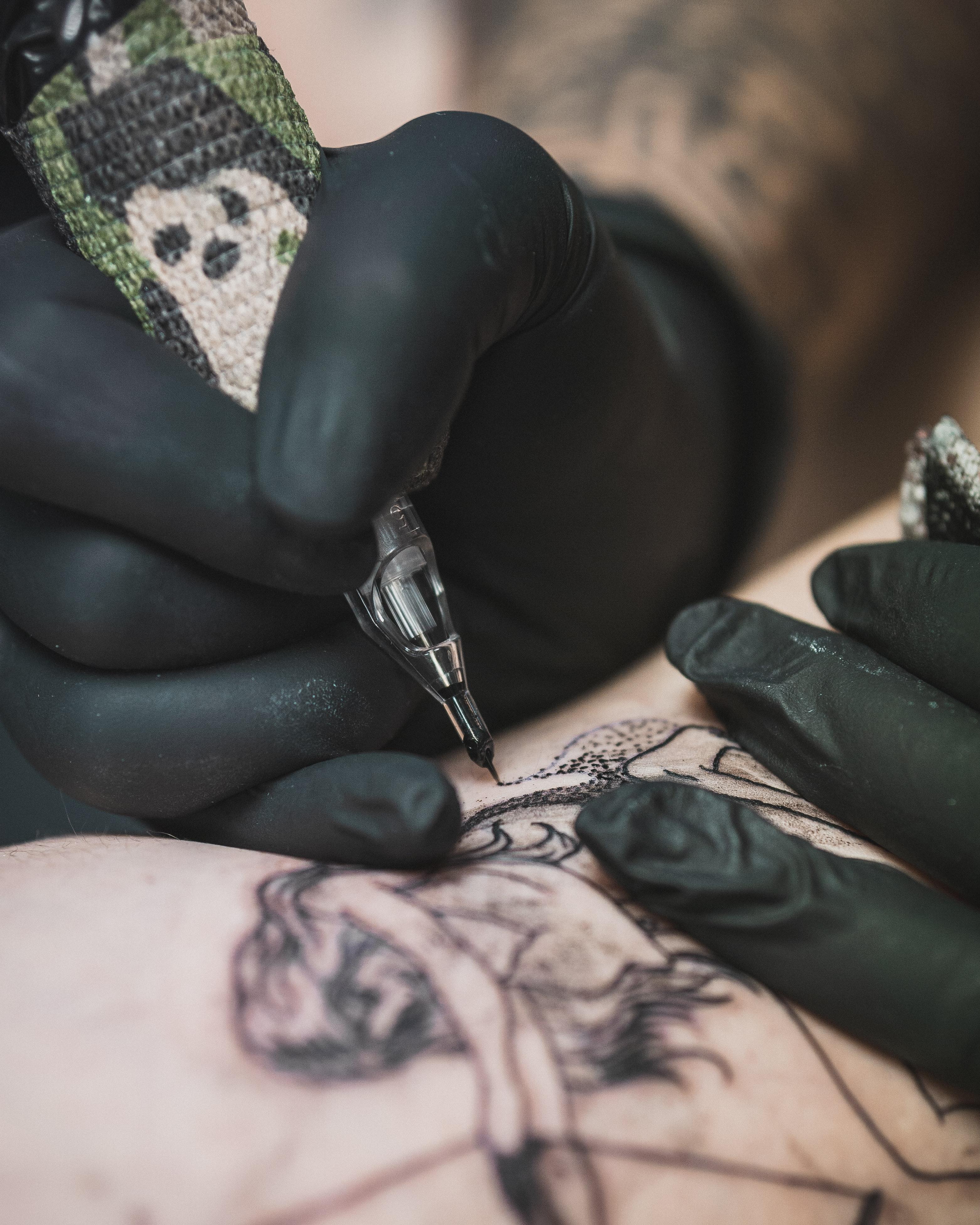
Configuration choice is made at the bench, not on the specification sheet alone. Image: CREDITECH MED.
Problem Definition: Why the Wrong Configuration Costs More Than the Cartridge
Configuration errors rarely announce themselves immediately. They surface as extra passes, uneven saturation, or healing that looks harsher than the design intended — and each of those outcomes costs more time than the cartridge itself.
- Using a Magnum where a liner belongs. A broad grouping cannot hold a consistent line weight; the artist compensates with extra passes, which increases skin trauma and slows the session.
- Using a liner where a shader belongs. Narrow groupings concentrate trauma and slow coverage; gradients become patchy instead of smooth.
- Ignoring taper length. Taper determines how much of the needle tip is exposed to the skin. A short taper on a fine line design gives less forgiveness; an unnecessarily long taper on dense packing work gives less support.
- Ignoring diameter. Diameter affects penetration behaviour and line character. A 0.15mm tip and a 0.35mm tip behave differently even inside the same configuration family.
- Ignoring the membrane and housing. An unstable cartridge vibrates at the tip, and vibration shows up in the work. A silicone anti-backflow membrane exists to keep ink out of the machine and to support stable, controlled ink delivery.
The practical consequence: configuration, diameter, taper, and cartridge stability are one decision, not four.
Industry Background: Why Configuration Vocabulary Became a Procurement Skill
Cartridge needles are now the default format for professional work. According to Custom Market Insights (2026), approximately 73% of professional tattoo artists preferred needle cartridges over traditional bar needles in 2024, and the global tattoo needle market was valued at USD 368.3 million in 2024, with a forecast CAGR of roughly 3.5% to USD 468.6 million by 2033 (Custom Market Insights, 2026).
The cosmetic side is growing on a different curve. Fortune Business Insights (2026) projects the global permanent makeup market growing from USD 162.93 million in 2025 to USD 330.5 million by 2034, at a CAGR of 8.31%. That matters for configuration planning because PMU and SMP work draw on the same cartridge families as tattoo work but depend on much narrower diameter and taper choices.
Tattoo cartridge needles are classified under HS code 9018.39, and manufacturers that serve regulated markets typically operate under a quality management system — ISO 13485:2016 is the standard applied to medical-grade tattoo needle manufacturing. In practice, that means configuration vocabulary, sterility documentation, and dimensional tolerance are now reviewed together by studios, distributors, and private-label brand owners.
Detailed Solution: The Five Configurations and What Each Actually Does
The SP5 tattoo needle cartridge is a useful reference point because its classification already separates applications rather than only selling a generic cartridge. The SP5 type set lists Fine Line Tattoo Cartridge Needle, Traditional Tattoo Cartridge Needle, Shading Cartridge Needle, Color Packing Cartridge Needle, PMU Eyebrow Needle Cartridge, SMP Scalp Micropigmentation Needle, Long Taper Precision Needle and Soft Edge Magnum Needle — and the range is supplied in RL, RS, RM, Magnum and Flat configurations with needle diameters of 0.15mm, 0.20mm, 0.25mm, 0.30mm and 0.35mm, and taper lengths from 1.5mm to 7mm, with extra long taper available.
RL — Round Liner
RL is the lining configuration. Needles are grouped in a tight round bundle, which concentrates pigment into a narrow, defined point. RL is the correct starting point for fine line outlines, traditional outlines, and PMU hair strokes — the last of these only when it is paired with a small diameter and a long taper, because the exposed tip length controls how soft the entry feels on cosmetic skin.
RS — Round Shader
RS keeps a round profile but spreads the grouping, so it deposits pigment over a slightly wider band while retaining directional control. It is the configuration for shading in constrained areas — small blends, transitions around detailed work, and colour work where a magnum would be too broad to control.
RM — Round Magnum
RM sits between the liner and the magnum. It is grouped as a round-style magnum and is generally used where an artist wants wider coverage than RS but more control than a full magnum. For artists working across both lining and soft shading in the same session, RM reduces the number of cartridge changes without pushing them into a broad grouping they cannot steer.
Magnum — Soft Edge Magnum
Magnum configurations group needles across a wider front, which is why they are the standard choice for large-area shading, colour packing, and smooth gradients. The SP5 range includes a Soft Edge Magnum type specifically for this role: broader coverage per pass, softer edges, and fewer passes over the same skin. The trade-off is precision — a magnum is not a lining tool and should not be used as one.
Flat
Flat groups needles in a straight row rather than a round bundle. It produces a broader, flatter contact pattern suited to texturing, whip shading, and specialist edge work where a round grouping would be too concentrated. Flat is a specialist configuration rather than a daily driver, which is why it usually ranks last in a starter stock list but stays in the drawer for artists who use texture deliberately.
Ranked by Application: 1 to 5
The ranking below is ordered by application fit across fine line, PMU and shading work — the three procedures where configuration errors surface fastest in the finished result.
1. RL — highest application coverage
RL earns the top position because it is the only configuration that serves fine line, traditional lining, and PMU hair strokes without substitution. In the SP5 range, RL is available from 0.15mm through 0.35mm, so the same configuration can cover a 0.15mm cosmetic hair stroke and a firmer traditional outline by changing diameter and taper rather than changing configuration family.
2. Magnum (Soft Edge Magnum) — highest efficiency for shading
For shading and colour packing, Magnum delivers the most coverage per pass. Where a project involves large gradients, background work, or colour blocks, Magnum reduces passes and produces softer edges than a round grouping. It ranks second only because it cannot substitute for a liner.
3. RS — best control for small-area shading
RS is the shading tool for areas a magnum cannot reach or would over-cover. When a gradient has to stop precisely at a line, RS keeps the blend under control. It ranks third because its practical range is narrower than RL or Magnum.
4. RM — best bridge configuration
RM earns its place where an artist moves between lining and mid-coverage shading inside one session. It is a productivity configuration rather than a specialist one, which is why it ranks below the three primary tools but still belongs in a professional stock list.
5. Flat — best specialist texturing
Flat is the least universal and the most distinctive. For textured shading, whip effects, and specific edge work it produces results that round groupings cannot match, but for routine lining and coverage it is the wrong tool.
Step-by-Step: Matching a Configuration to a Procedure
- Define the line weight first. If the design depends on a defined outline — fine line, traditional, PMU hair strokes — start with RL. Configuration follows the outline, not the shading.
- Define the coverage area second. Large gradients and colour blocks point to Magnum; constrained blends point to RS; sessions that move between lining and mid-coverage point to RM.
- Set the diameter. Choose from the available 0.15mm, 0.20mm, 0.25mm, 0.30mm and 0.35mm range according to how fine the entry needs to be. Cosmetic and fine line work sits at the narrow end; firmer lining and packing sit at the wider end.
- Set the taper. Taper length runs from 1.5mm to 7mm, with extra long taper available. Long taper supports softness and precision at the tip; short taper supports support and stability in dense work.
- Confirm the build. Medical-grade stainless steel needles, medical-grade PC housing, a silicone anti-backflow membrane, a non-toxic transparent plastic tip, stable controlled ink delivery, low vibration design, and a precision tolerance of ±0.02–0.05mm are the specifications that determine whether the configuration behaves predictably at the tip.
- Confirm sterility and machine fit. The cartridge must be EO gas sterilized, packed in a sterile breathable film packaging system, single-use, and compatible with rotary tattoo machines.
- Validate with a sample before committing. Test the exact configuration, diameter, and taper combination on the machine you actually run before placing a volume order.
Use Cases: Configuration in Practice
Fine line tattooing
Fine line work depends on a narrow RL and a long taper. The objective is a consistent line without repeated passes, so precision tolerance and low vibration matter as much as the configuration itself. A cartridge that wobbles at the tip cannot hold a fine line regardless of grouping.
PMU brows, lips, and liner
PMU uses the same cartridge families under different constraints: narrow diameters, long tapers, and stable ink delivery. RL covers hair strokes and liner detail; RS or a small Magnum covers lip blush and soft shading. The SP5 range classifies PMU Eyebrow Needle Cartridge as its own application type, which reflects how differently cosmetic work treats the same configuration vocabulary.
SMP (scalp micropigmentation)
SMP is a density and repetition procedure, so consistency across many small deposits matters more than coverage speed. SMP Scalp Micropigmentation Needle is listed as a distinct SP5 type, and the anti-backflow membrane plus stable ink delivery matter here because the work is long and repetitive.
Traditional lining and colour packing
Traditional work pairs firmer RL diameters for outlines with Magnum groupings for colour packing and background shading. The Soft Edge Magnum type exists specifically to soften magnum edges, which is where large colour fields show quality first.
Realism and soft shading
Realism relies on layered, low-trauma shading. RS handles controlled transitions; Magnum handles broad soft gradients. Both depend on a cartridge that delivers ink consistently instead of surging.
Textured and whip shading
Flat groupings create the broken, textured edge that round groupings cannot produce. This is a deliberate stylistic choice rather than a default, which is why Flat stays a specialist item.
Build, Sterility, and Machine Fit
Configuration only performs as designed if the cartridge around it is stable. The reference build for the SP5 range combines medical-grade stainless steel needles with a medical-grade PC housing, a silicone elastic anti-backflow membrane, and a non-toxic transparent plastic tip, assembled to a precision tolerance of ±0.02–0.05mm.
Sterility is a separate decision from configuration. Cartridges are EO gas sterilized and supplied in a sterile breathable film packaging system as single-use devices, and they are compatible with rotary tattoo machines. For buyers in regulated markets, EO sterilization records, batch traceability, and the quality management system behind them should be requested alongside the specification sheet. ISO 13485:2016 is the quality management system standard applied to medical-grade tattoo needle manufacturing, and CREDITECH MED states that it operates under an ISO 13485:2016 quality management system for tattoo cartridge needles, PMU cartridges, and SMP solutions.

Dimensional and functional inspection before sterile packing. Image: CREDITECH MED.
Comparison Table: Configuration and Specification Reference
The table below maps the five configurations to their application role, then lists the build specifications that apply across the SP5 range.
| Configuration | Primary application | Why it fits | Where it does not fit |
|---|---|---|---|
| RL (Round Liner) | Fine line outlines, traditional lining, PMU hair strokes | Tight round grouping concentrates pigment into a defined point | Large-area shading and colour packing |
| RS (Round Shader) | Small-area shading, transitions, detailed colour work | Wider round grouping with retained directional control | High-volume coverage where speed is the priority |
| RM (Round Magnum) | Sessions combining lining and mid-coverage shading | Coverage between RS and full magnum with steering control | Maximum-precision outlining |
| Magnum / Soft Edge Magnum | Large-area shading, colour packing, gradients | Broad grouping for coverage per pass and soft edges | Lining and fine detail |
| Flat | Textured shading, whip effects, specialist edge work | Straight needle row creates a broad, flat contact pattern | Routine lining and general shading |
| Specification | SP5 range |
|---|---|
| Needle diameters | 0.15mm / 0.20mm / 0.25mm / 0.30mm / 0.35mm |
| Taper length | 1.5mm – 7mm (extra long taper available) |
| Configurations | RL / RS / RM / Magnum / Flat |
| Needle material | Medical-grade stainless steel needles |
| Housing material | Medical-grade PC housing |
| Membrane system | Silicone anti-backflow membrane |
| Tip | Non-toxic transparent plastic tip |
| Precision tolerance | ±0.02–0.05mm |
| Ink flow | Stable controlled ink delivery system |
| Vibration | Low vibration design |
| Sterilization | EO gas sterilized |
| Packaging | Sterile breathable film packaging system |
| Compatibility | Compatible with rotary tattoo machines |
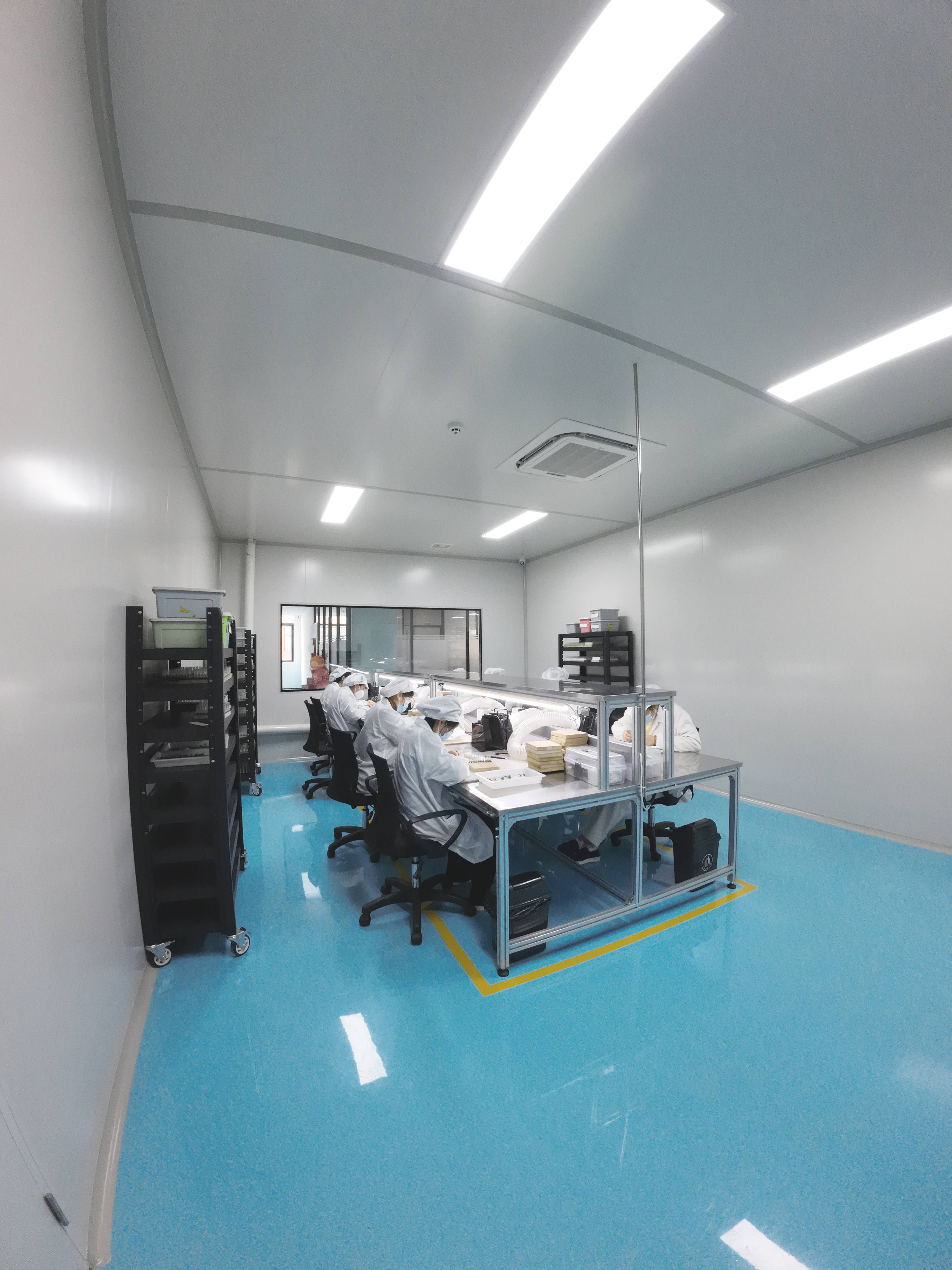
Cartridge needle production under an ISO 13485 quality management system. Image: CREDITECH MED.
Supplier Context: What Configurations Tell You About a Manufacturer
Suzhou Creditech Electronic Technology Co., Ltd. (CREDITECH MED) is a manufacturer of tattoo cartridge needles, PMU cartridges, and tattoo consumables, founded in 2009 and based in Suzhou, China, with an annual output of 100,000,000 units and exports to Europe, North America, South America, and Southeast Asia. The company operates the SPACEDRAGON TATTOO, ESTLIA, and LPT Tattoo Supply brands and provides OEM and ODM services covering product development, structural design, prototyping, mass production, and custom packaging.
Configuration breadth is a useful screening signal for buyers because a supplier that lists RL, RS, RM, Magnum and Flat across a 0.15mm–0.35mm diameter range and a 1.5mm–7mm taper range is usually organised around application types rather than a single generic cartridge. Buyers should still verify that breadth against samples, documentation, and certificate records before committing volume.
FAQ
Do PMU salons need EO-sterilized cartridges from an ISO 13485 quality system?
Sterility and quality-system evidence should be treated as baseline requirements rather than upgrades, because PMU and SMP procedures break the skin and are performed repeatedly on the same client base. CREDITECH MED states that it operates under an ISO 13485:2016 quality management system, that its cartridges are EO gas sterilized, and that they are supplied in a sterile breathable film packaging system as single-use devices. ISO 13485:2016 is the quality management system standard applied to medical-grade tattoo needle manufacturing. Buyers should request the certificate, its scope and validity dates, and batch records, and should verify the certificate against the issuing body's record rather than relying on a website claim alone.
Which configurations should a PMU salon stock first?
Stock by procedure, not by variety. RL in a small diameter with a long taper covers brows, hair strokes, and liner detail, because a tight round grouping concentrates pigment into a defined point. RS or a small Magnum covers lip blush and soft shading, where a wider grouping gives smoother coverage. Flat is a specialist item for textural work rather than a first purchase. The SP5 range supports this structure directly: it lists PMU Eyebrow Needle Cartridge and SMP Scalp Micropigmentation Needle as separate application types, and supplies RL, RS, RM, Magnum and Flat across 0.15mm to 0.35mm diameters with 1.5mm to 7mm tapers.
What should a PMU salon check when qualifying a tattoo cartridge needle manufacturer?
Check four things against documentation rather than brochures: configuration and diameter coverage, quality control, customization capability, and supply continuity. CREDITECH MED states ISO 13485 quality management, 100% inspection, EO sterilization, and batch traceability, and offers OEM and ODM services including custom logo, private label, custom packaging, needle configuration, housing design, and new product development. Its stated export markets include the USA, Germany, UK, France, Brazil, Mexico, Colombia, Canada, and Australia. Ask for the certificate scope, a batch record sample, and a sample cartridge from the exact configuration you intend to stock.
What order quantities and budget factors apply?
For CREDITECH MED, the stated MOQ is 500–1,000 pcs per size, with a standard lead time of 15–30 days and 30–45 days for custom OEM orders. Budget planning should account for per-size MOQs rather than a single total, because a configuration-and-diameter matrix multiplies the number of sizes in an order. Narrowing the matrix to the configurations you actually use — typically RL plus one shading configuration — is the most direct way to control both inventory cost and dead stock.
Can a salon or distributor test configurations before committing to volume?
Yes, and testing should come before volume. Request samples in the exact configuration, diameter, and taper you plan to use, then evaluate line consistency, ink delivery stability, vibration at the tip, and membrane behaviour on the machine you actually run. CREDITECH MED supports fast sample development alongside its OEM and ODM programs, so configuration and packaging can be validated before a production order. To start a sample or quotation request, contact the team by email at estlia@creditechmed.com or WhatsApp on +86 18625276381, or review the range at creditechmed.com.
Conclusion
Configuration is a decision about the mark you intend to make, and the five core families answer five different questions. RL concentrates pigment into a defined point for fine line, lining, and PMU hair strokes. RS keeps shading controllable in tight areas. RM bridges lining and mid-coverage work. Magnum, including the Soft Edge Magnum type, handles broad shading and colour packing. Flat produces texture that round groupings cannot. Diameter then sets how fine the entry is across the 0.15mm–0.35mm range, and taper — 1.5mm to 7mm with extra long taper available — sets how much of the tip meets the skin.
What holds the decision together is the build behind the grouping: medical-grade stainless steel needles, medical-grade PC housing, a silicone anti-backflow membrane, ±0.02–0.05mm precision tolerance, low vibration, stable controlled ink delivery, EO gas sterilization, sterile breathable film packaging, and rotary machine compatibility. Choose the configuration by procedure, verify the specification by document, and confirm both with a sample before the first volume order.
Next step: request SP5 samples in your target configuration, diameter, and taper — or ask for the full product catalogue and OEM/ODM terms.
Email: estlia@creditechmed.com | WhatsApp: +86 18625276381 | Web: creditechmed.com
Download the company brochure: CREDITECH MED Company Profile (.docx)
Suzhou Creditech Electronic Technology Co., Ltd. — 3rd Floor, Building 3, No. 3000 Taidong Road, Xiangcheng District, Suzhou, China.

Sample and production orders packed for export. Image: CREDITECH MED.
Have Questions or Need More Details?
Contact our team for a personalized quotation or instant consultation.
Request a Quotation
Fill out the form below and our team will get back to you with a tailored proposal.
WhatsApp Direct Chat
Prefer to chat in real-time? Message us on WhatsApp for instant assistance & quick answers.
- Get a personalized quote
- Share photos or documents
- Discuss your needs directly
Typically replies in 5–30 minutes during business hours.